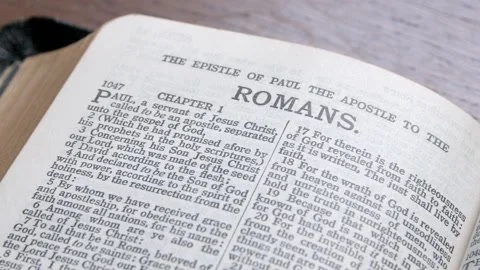
🏳️🌈🏺🛐 Romans
🏳️🌈🏺2-Gay in History: Bible 12🛐🏳️🌈
If you grew up in a church, you know this one. Romans 1 is the passage most deployed against queer people in the New Testament, and unlike Leviticus — which most Christians quietly set aside along with the rest of the Holiness Code — this one comes from Paul, in the New Testament, and it hurts. Can’t sugar coat this one, but sugar can cover bitter medicine.
So let’s start with what the passage is actually doing.
Romans is a letter Paul is writing to a specific congregation in Rome — a mixed community of Jewish and Gentile Christians with a lot of tension between them. Right off the bat Paul opens by beating up on the Gentile, who abandoned God for idols and were thus “given up” by God to disordered passions like same-sex acts — but also things like being boastful, ruthless, or a gossip. The Jews in the community would have finished the first chapter smiling and nodding.
But then comes the sucker punch, Romans 2:1: “Therefore you have no excuse, O man, every one of you who judges. For in passing judgment on another you condemn yourself, because you, the judge, practice the very same things.”
This is the bitter medicine hidden in the letter. The supposedly holy ones are condemned for judging while being no better than the Gentiles — a deliberate rhetorical setup designed to catch self-righteous people in the act of condemning others. Paul gets his audience gloating at the sins of pagans, then turns the entire argument back on them. Paul uses homosexuality because it was so visible in Greco-Roman culture but condemned in Jewish thought, but then goes on to list numerous other sins, so long everyone feels called out.
Even the most conservative scholars acknowledge this is what Paul is architecturally doing. The passage most used to condemn queer people was written to condemn exactly the kind of person using it that way. That’s why you should always read the whole chapter before and after the verse.
Romans is indicting the accuser and giving them a bitter pill to swallow.
But there is more.
Paul is not describing same-sex acts as the sin — but as the consequence. The structure of the passage is: Gentiles abandoned God → God gave them up → disordered passions followed. Same-sex acts appear as a symptom of idolatry, not as their own subject of condemnation. Paul is telling a morality tale about what happened to a specific people in a specific context — not necessarily legislating for Christian relationships across all time.
Professor Dale Martin makes the crucial point: Paul is not giving an account of homosexual desire as such. He is describing Gentile idolaters.
The key phrase is ‘para phusin’ — usually translated “against nature.” It sounds categorical. But three chapters later, in Romans 11:24, Paul uses the exact same phrase to describe God grafting Gentiles into Israel — something Paul presents not as an abomination but as a miracle of grace. “Against nature” doesn’t mean eternally and absolutely forbidden. It means something more like “not the usual way of things” or “outside the expected order.” The ancient mind was far more concerned with excess and lack of self-control — and that seems to be what this passage is actually about.
A note on ‘malakoi’, the other word in this family of passages — see our earlier post on arsenokoitai, where we addressed it directly. The same problem applies: a word translated into a category it was never meant to carry.
But let’s be honest: Romans 1 is still the strongest biblical case against us. It is Paul. It is the New Testament. It mentions women as well as men. Even some queer-affirming scholars argue Paul knew about same-sex relationships beyond exploitative contexts and condemned them anyway. More on that in the comments.
But here is what does not require a footnote or debate: Paul wrote this passage as an intentional trap. He wrote it to stop people from using exactly this kind of catalog of sins to condemn others while exempting themselves — and the sin list is long, with same-sex acts as just one among many.
And then he followed it immediately with some of the most expansive language of grace and inclusion in all his letters.
Romans was not written to give anyone a weapon. It was written to make weapons backfire.
If this passage has been used against you, you were not the one Paul was condemning. Romans 2 is the best response to Romans 1.