🏳️🌈🏺Secret Lazurus: Bible 10
🏳️🌈🏺 2-GAY IN HISTORY: Bible 10🛐🏳️🌈
At Easter Christians celebrate the resurrection, but it wasn’t the first resurrection in the gospels — and there is something secret about Lazarus.
In John 11, Jesus receives a message: “Lord, the ONE YOU LOVE is sick.” The Greek word is ‘phileis’ — intimate, personal love. Not the selfless divine love, ‘agape’. But deep love for a specific person.
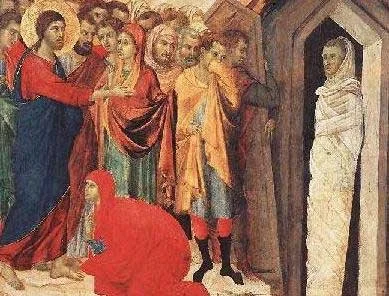
Jesus eventually travels to Bethany but finds Lazarus already four days in the tomb. He sees Mary and Martha weeping. He sees the crowd’s sadness. And then in the shortest verse in the Bible: “Jesus wept.” The crowd’s response is immediate: “See how he loved him” — Greek word ‘ephilei’, same root. The love is public and unguarded. In uniquely John fashion, the text presents none of it with anxiety.
Lazarus is the only other figure in the Gospel described with the same language used for the Beloved Disciple. Some scholars have argued they may be the same person, though that is contested and discussed in our last post. What matters here is what the text makes plain: this is the person Jesus loved most visibly, grieved most publicly, and raised from the dead.
The raising of Lazarus appears only in John, but there is another version of this story — or something very close to it, even set in Bethany — that may never have been cut from the Bible. In a letter attributed to Clement of Alexandria, written to defend the text against a Gnostic sect already reading it sexually, confirms the passage existed but was kept strictly guarded. Clement explicitly denies a sexual interpretation, but the fact that he has to deny it tells us that a sexual reading of this passage is not a modern imposition. It is as old as the text itself, and the early church was anxious about it.
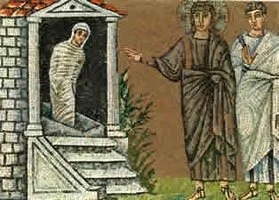
The letter was found in the 1950s by biblical scholar Morton Smith at a monastery in the Judean desert, quoting a passage from a longer version of Mark — a version it calls the Secret Gospel of Mark. The passage describes Jesus arriving at a tomb, rolling away a stone, and raising a young man — Greek word ‘neaniskos’ — who had died, much the same as Lazarus, but with a very different scene after.
The raised young man looks at Jesus and “looking upon him, loved him and began to beseech him that he might be with him.” He then comes to Jesus late at night, wearing only a linen cloth — Greek word ‘sindon’ — over his naked body, something the text makes special note of. And then he spends all night with Jesus, being taught “the mystery of the kingdom of God.” I wonder why the ancient gnostics thought this sounded sexual?
The scene echoes something even earlier in the Bible. In 2 Kings 4, Elisha raises the Shunammite woman’s son by lying directly on top of him — mouth to mouth, eyes to eyes, hands to hands. Physical contact, intimacy, and resurrection are already threaded together in the tradition Secret Mark is drawing on.
But the most compelling evidence to its veracity is in canonical Mark itself.
At Gethsemane, in Mark 14:51-52, a young man — ‘neaniskos’ again, the same specific word — follows Jesus wearing only a linen cloth, ‘sindon’, again, and flees naked when the soldiers seize him. He has no name, no seeming purpose, no explanation. He appears nowhere else in Mark. Scholars have puzzled over him for centuries because he makes no narrative sense unless he is a remnant of something earlier that was cut.
Harvard scholar Helmut Koester argues just that — that both derive from a common source, with canonical Mark being a later edited version that removed the Secret Mark episode but inadvertently left this orphaned naked figure behind.
There is a minority of serious scholars who believe the excerpt from Secret Mark may be a forgery. But Koester’s textual argument rests on internal literary evidence, and would explain why Lazarus’s resurrection was not echoed in Mark and the lost reference to the ‘neaniskos’.
The early church fathers, like Clement, decided what went into the Bible and what got left out, and they are known to have edited Mark’s gospel before, most notably by adding a different ending to it. It seems possible that the Bible was edited again to remove these ambiguous lines of intimacy and love between men—even nearly naked ones.