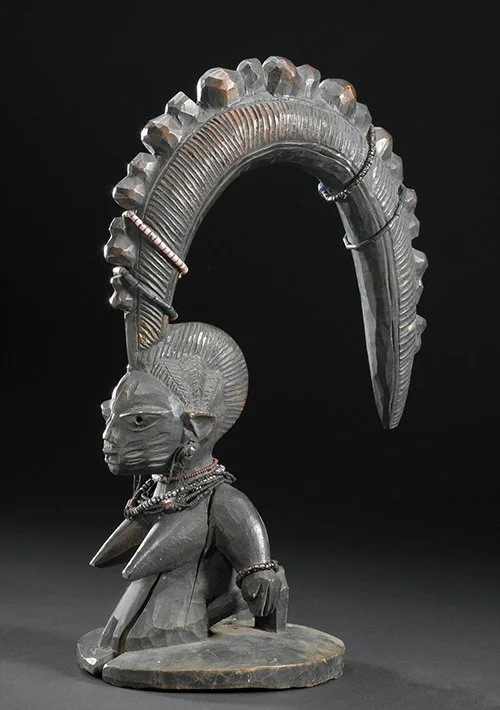
🏳️🌈🏺Esu and pre-colonial Nigerian queerness
🏳️🌈🏺 2-Gay in History 🏺🏳️🌈
Before British missionaries made Africa straight by law in 1861, the crossroads of Africa already had a bendy guardian.
His name is Eshu, the divine messenger, keeper of àṣẹ (spiritual power), master of paradoxes in the cosmology of Yurobaland of modern day Nigeria and its neighbors.
He was the conduit between the people and the divine, and he’s ways weren’t straight.
One famous tale tells of Èṣù strolling between two farmers wearing a hat split down the middle — red on one side, black on the other. Each man swore the hat was a different color, worn by a different gender. The village divided. Only later did Ehsu reveal the trick: both were right. Truth depends on perspective. Reality has more than one face, as his depictions often show.
In Yoruba thought, divinity is relational, not biological. Spiritual power is not confined to anatomy, as Eshu appeared as both man and woman, and both. In possession rituals, devotees embody the divine spectrum fully. The body becomes vessel, changing roles. Gender would invert, expand, & transcend. Men dressed as women, women took on men’s roles, all in devotion to the divine.
But Eshu governs liminality, breaking simple categories. When 19th-century missionaries encountered him, they flattened him into “the devil.” Ambiguity, after all, is threatening to hierarchies.
Before Victorian morality enforced categories with the Offenses Against the Person Act of 1861, West African cosmology allowed for openness, and the history shows no pre-colonial stigma against homosexuality, frequent intimate male pairings, and plenty of people crossing gender, just like their god Eshu.
The damage of that 1861 law still effects Nigeria today, where a decade ago (in the Same Sex Marriage Prohibition Act) they outlawed even saying you are gay, advocating for gay rights —and in much of the country— homosexual acts carry the death penalty. Their government framed the law as resisting “Western (gay) Values” … a trick even Eshu wouldn’t tell.