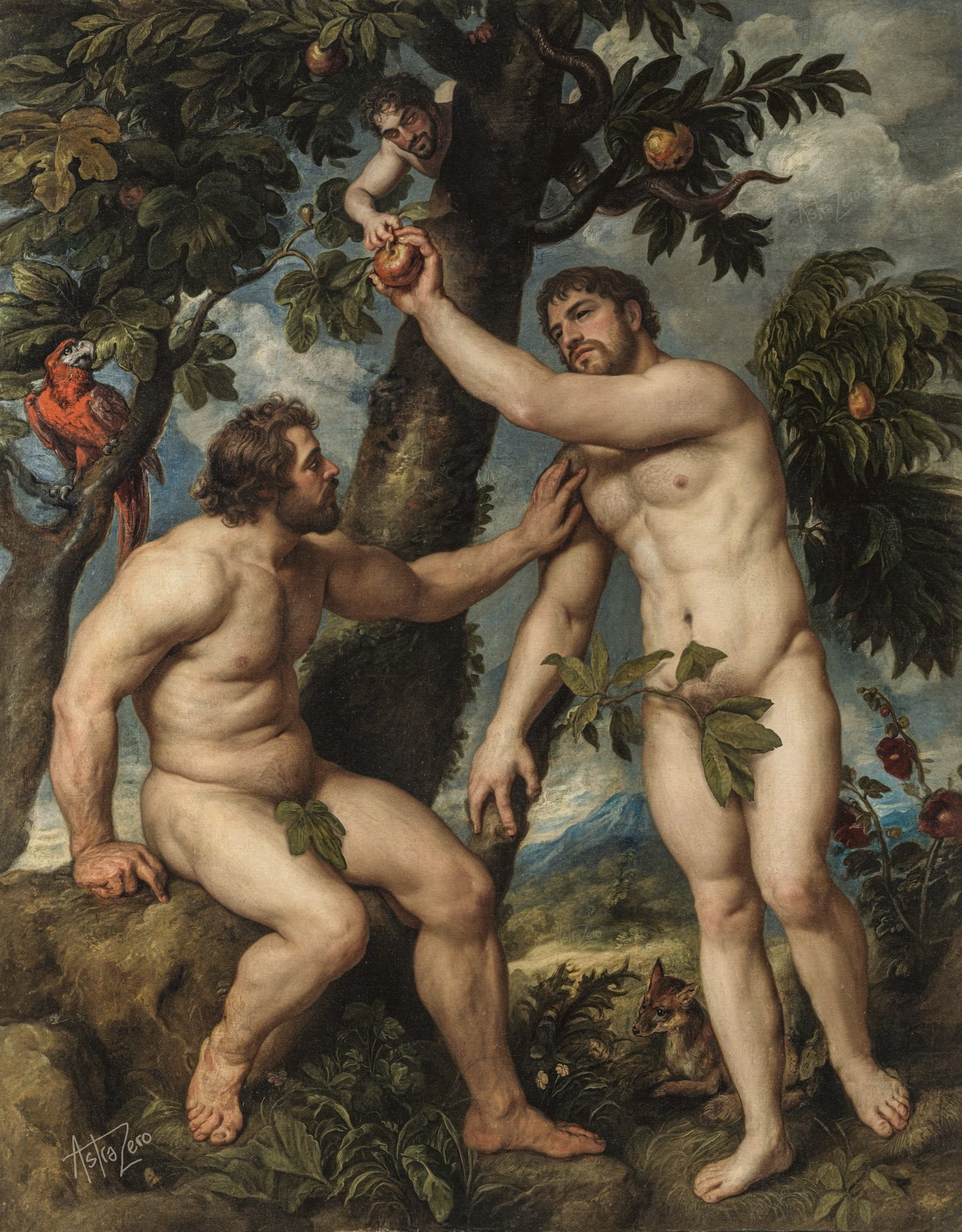
🏳️🌈🏺2-Gay in History: Bible Series 1🏺🏳️🌈
Genesis doesn’t enforce heterosexuality—it sanctifies companionship.
The sacred good is not “male with female,” but human with a partner who corresponds, who complements.
Genesis 2 is often invoked to defend ‘traditional’ marriage yet the story’s own logic points somewhere more inclusive. When read closely, Genesis becomes less a rulebook about gender and more a meditation on human companionship.
The narrative begins not with “man” but with ’adam—a gender-nutural (undifferentiated) human formed from the earth. The first divine assessment in the Bible is:
“It is not good that the human should be alone.” G-2:18 (4218 for Bible posts the first letter of the book, chapter and verse quoted will be the weekly code)
The first issue is isolation.
Unfortunately for that Oklahoma Psychology student, she’d get a 0 in hermanutics as well
God promises to make a “helper”“corresponding to” the human (ʿēzer kenegdô).
‘ēzer’ is used mostly of God helping Israel—so it cannot mean an obedient wife.
‘Kenegdô’ means “matching, facing, equal, corresponding.”
This is the relational condition: a partner who answers the human’s loneliness with mutual support.
The text then depicts God forming animals—not as comic relief, but as a process of discernment. None are found to be a true counterpart. The goal is not heterosexual pairing; the goal is finding the one who corresponds, like to adam.
Scholars like Phyllis Trible and Ken Stone argue that the hermeneutical key is this:
Genesis 2 does not prescribe a universal model of “one man + one woman” (the Bible was definitely open to polygamy)
It narrates God’s search for a relationship of equality and mutual comfort.
From this logic, queer theology makes a natural—though not original (see the Talmud)—conclusion:
If God’s concern is the human need for a partner who truly corresponds, then any relationship that embodies mutual help, shared life, and chosen companionship fulfills the text’s purpose.
This is not claiming the ancient author intended to affirm gay love; rather, it’s following a canonical pattern where later communities draw broader, life-giving meanings from earlier stories, where no one must walk alone.
As James Alison puts it: Scripture invites us into “a continuing discovery of what makes for human flourishing.” Genesis 2, read faithfully, says flourishing comes when no one is left to walk alone.
COMMENTARY & HERMENEUTICS: “NOT GOOD TO BE ALONE” THROUGH ANCIENT JEWISH EYES
What’s striking is that ancient Jewish interpreters themselves read Genesis 2 the same way queer theologians do today: as a story about companionship, mutuality, and the search for a “corresponding partner”—not a mandate for strict gender roles.
1️⃣ The rabbis said the core problem in Genesis 2 is loneliness.
Genesis Rabbah 17:2:
“A human without a companion is not a human.”
The issue is isolation, not sexuality. God’s goal is social wholeness.
2️⃣ The partner (“helper corresponding to”) is an equal, not a subordinate.
Rabbinic tradition notes that ʿēzer is a word mostly used for God, and kenegdô means “equal to him / fit for him.”
Even the ancient Targums translate it as “a partner appropriate for him.”
3️⃣ God’s search for a partner is interpretive, not anatomical.
Midrash teaches that God brings the animals to Adam as part of a discernment process (Gen. Rab. 17:4; b. Yevamot 63a).
The question is not “Are you opposite enough?” but “Do you correspond?”
4️⃣ Early rabbis believed the first human wasn’t male.
Genesis Rabbah 8:1:
“When the Holy One created the first human, He created it double-faced, then split it.”
In other words, Adam was originally androgynous—gender comes later, as part of forming relationship.
5️⃣ Marriage in the Talmud is covenantal, not biological.
The Mishnah defines marriage through acts of commitment, not reproduction or anatomy.
And b. Yevamot 62b–63a notes that “be fruitful and multiply” doesn’t bind everyone—relationship itself has value.
👉 None of this affirms same-sex marriage in antiquity.
But all of it supports the deeper principle that Genesis 2 teaches:
Human beings need partnership, presence, and someone who truly corresponds to them.
Queer love fits that ancient vision because it heals human loneliness with mutuality and covenant.